
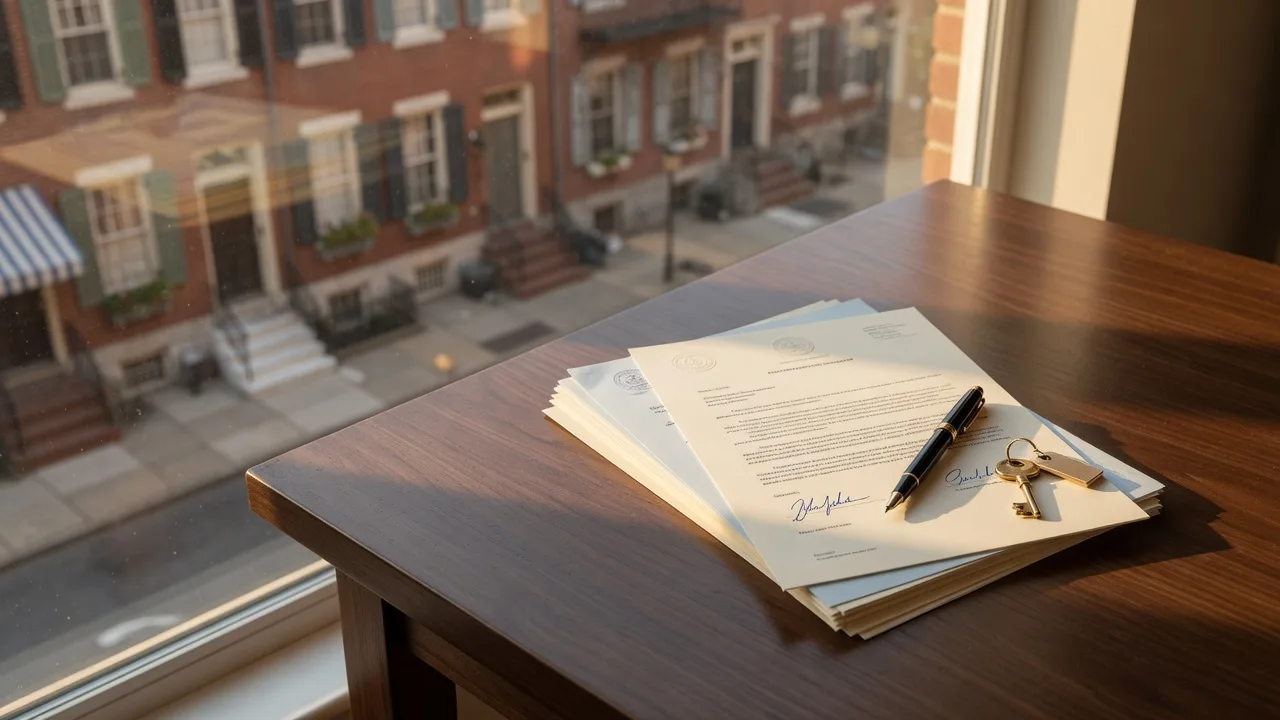
A financed home purchase in Pennsylvania runs about 30 to 45 days from the day both parties sign the agreement of sale to settlement, 37 days on average statewide, with cash deals closing in as little as one to two weeks. Pennsylvania does not require an attorney at closing, and your lender sets most of the clock. Verified September 2026.
Out-of-town buyers raise this inside the first ten minutes of a call. I'm Craig Lerch, a licensed real estate broker with eXp Realty, and I have worked the city and the four surrounding Pennsylvania counties for more than 35 years. Every figure below was verified in September 2026.
Two clocks: market time and process time
Plan on two clocks. First, market time: Philadelphia homes averaged about 50 days on market in the three months ending August 2026 (Redfin, verified September 2026). Second, process time: from the day both sides sign to keys, about 37 days on average statewide in 2026 data, with financed deals in a 30 to 45 day window and cash in 7 to 14 (ListWithClever analysis of MLS data, verified September 2026). Together, a smooth Philadelphia purchase runs about three months from first offer to keys.
What actually sets the pace
The lender sets the pace. An inspection, title search, and transfer paperwork each take days, but appraisal, underwriting, and final commitment consume most of the 30 to 45, and a completed pre-approval before you bid shortens that window measurably.
Pennsylvania is a title state: a title company or settlement agent normally conducts the closing, and the law does not require a real estate attorney (HomeLight state survey, verified September 2026). Philadelphia is an exception in custom, not law: buyers here commonly pay an attorney to review the agreement before signing.
Pennsylvania has no statutory attorney review period, unlike New Jersey. The standard Pennsylvania Association of Realtors (PAR) agreement is a form document with deadlines embedded in it, including a default 10 day inspection window, negotiated to 10 or 15 days in many deals (Pennsylvania Association of Realtors, verified September 2026).
Offer to settlement, step by step
- Sign a written buyer agency agreement before touring: since August 2024 an agent cannot show you MLS homes without one, and the fee is negotiable in writing (PAR Buyer Agency Contract, rev. 8/24).
- Read the Seller's Property Disclosure Statement: Pennsylvania's disclosure law (68 Pa.C.S. chapter 73) requires sellers to list known material defects before you sign; foreclosure, estate, court-ordered, and new-with-warranty sales are exempt.
- Write your offer on the standard PAR agreement, naming the settlement date and your contingencies.
- Use the default 10 day inspection window for the general inspection plus anything specific: sewer, roof, radon. Negotiate repairs or credits in writing.
- Let the lender finish appraisal and underwriting.
- Settle. The title company records the deed, collects the transfer tax, and you get the keys. Pennsylvania calls closing settlement, and you attend it at a table.
- Take possession at settlement unless your agreement says otherwise.
The numbers: transfer taxes are the big line item
The fee most buyers do not plan for is the realty transfer tax. Philadelphia's total is 4.578%: 1% to the state plus 3.578% to the city, where the city share rose from 3.278% on July 1, 2025 (City of Philadelphia, verified September 2026). By custom it is split 50/50, so on a $400,000 purchase the buyer typically brings about $9,156. The split is negotiable, and both parties stay liable until paid.
Cross one county line and the number falls by more than half: the standard total in Montgomery, Bucks, Delaware, and Chester counties is 2% (1% state plus 1% local), so the buyer's customary share on $400,000 is about $4,000. A few municipalities add more, roughly 2.5% in Radnor, Upper Darby, and Chester City, and 3% in Upper Providence and Coatesville (county recorder of deeds schedules, verified September 2026).
New Jersey and Delaware put the fee on a different side. New Jersey's Realty Transfer Fee is a graduated state tax nominally on the seller, though who absorbs it is negotiated at closing (NJ Division of Taxation, verified September 2026). Delaware's state tax is 3% split evenly, and with local add-ons New Castle County totals reach about 4% (Delaware Division of Revenue, verified September 2026).
City, suburbs, New Jersey, Delaware: one process, different prices
Inside Pennsylvania the process is one shape everywhere: standardized agreements, a title-company settlement, and the same 30 to 45 day clock. What changes is the price tag: Philadelphia's 4.578% versus roughly 2% in the collar counties means about $5,150 more buyer-side transfer tax on a $400,000 home in the city.
New Jersey is the attorney state. Every standard contract drafted by a licensee carries a mandatory three business day attorney review window (N.J.A.C. 11:5-6.2), and most buyers use an attorney, commonly at a flat $995 to $2,500. Buyer closing costs there run about 2% to 5% of the purchase price (New Jersey sources, verified September 2026).
What surprises someone moving from California
The clock is not the surprise: California escrow runs about 30 to 45 days for financed purchases and 7 to 14 days for cash, nearly the same numbers (California escrow guides, verified September 2026).
The vocabulary and the players. Californians say escrow and hand the file to a neutral escrow officer; Pennsylvanians say settlement and hand it to a title company. In California an attorney is rare in a residential deal; in Philadelphia buyers commonly retain one to review the agreement before they are bound. You can also sit at an actual settlement table, which surprises Californians used to escrow offices.
The tax is an order of magnitude apart. California's standard documentary transfer tax is $1.10 per $1,000, about 0.11%, customarily on the seller (Revenue and Taxation Code section 11911, verified September 2026). Philadelphia's 4.578% total puts roughly 2.3% on the buyer: about $9,150 of transfer tax on a $400,000 purchase.
The disclosure forms are cousins, not twins. California wants its Transfer Disclosure Statement (Civil Code section 1102) before the contract; Pennsylvania wants its own Seller's Property Disclosure Statement before you sign. Read the Pennsylvania form line by line rather than assuming it matches.
What most people get wrong
- Closing takes 60 to 90 days. A standard financed deal in Pennsylvania runs 30 to 45; the long end appears with jumbo or specialty loans, or a title problem that needs time to cure.
- Pennsylvania requires an attorney. It does not; title companies run closings. Philadelphia buyers commonly hire one anyway, and New Jersey buyers almost always do.
- The seller pays the transfer tax. By custom it is split 50/50, both parties stay liable until paid, and the split is negotiable, so read the line.
- The 10 day inspection window is fixed. It is a PAR default, negotiated to 10 or 15 days, and extendable by mutual agreement.
- A missing disclosure is a small thing. A seller who willfully or negligently hides a known material defect can owe your damages plus attorney fees (68 Pa.C.S. section 7311).
First-time buyer help that changes the calendar
Two programs can move your dates if you start them early. Philadelphia's Philly First Home grants up to $10,000 or 6% of the purchase price toward down payment and closing costs; it is open to buyers at or below 120% of area median income who have not owned a home in three years, applies to single-family homes and duplexes rather than condos, and requires homeownership counseling before you sign an agreement of sale (City of Philadelphia DHCD, verified September 2026). Start the counseling before the search, not after.
Statewide, the Pennsylvania Housing Finance Agency's Keystone Advantage Assistance Loan adds a 0% second mortgage of up to 4% of the price, capped at $6,000, repaid over 10 years (PHFA, verified September 2026). Programs change and funds run out, so confirm availability with the agency before budgeting around any figure.
Your concrete next step
Do four things before you tour: complete a pre-approval with a lender that closes on time locally, sign a buyer agency agreement, decide with your agent whether the deal warrants attorney review, and put the dates on a calendar, because the clock runs from the day both sides sign.
Ask for the free relocation-timeline worksheet when you reach out: it lays pre-approval, inspection, settlement, and move-out on one calendar so the clock stops being a guess. I will send it with your first call.
Related reading
- The Main Line: a suburban Pennsylvania reference point for the 2% transfer tax
- Center City: where every sale carries Philadelphia's 4.578% rate
- The relocation buyer's checklist: what to line up before the offer
- What moving to Philadelphia really costs: the other side of the math
- City or suburbs: where the tax tables and the process change