
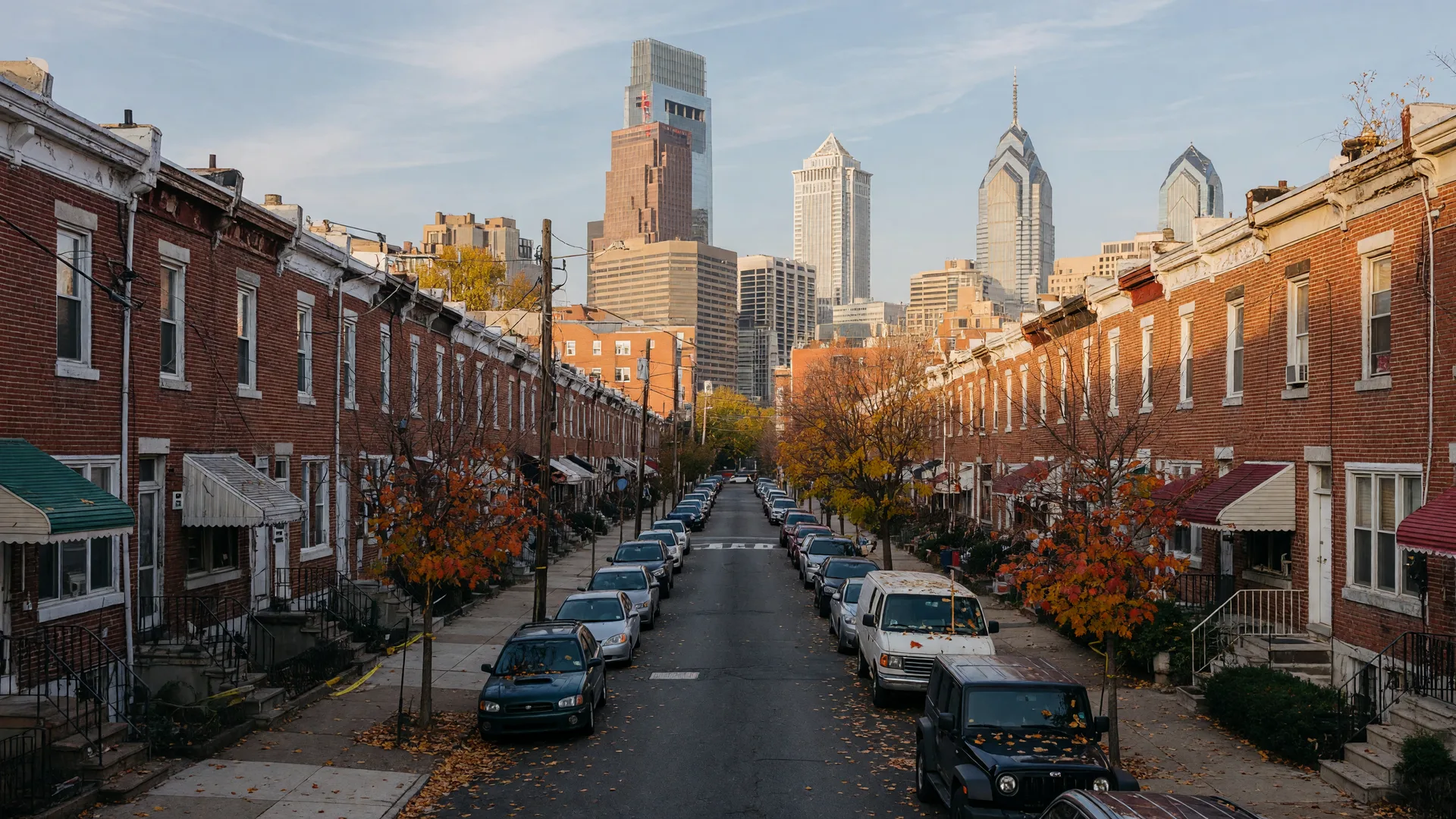
Philadelphia flips the metro pattern: the city usually costs less than its suburbs. The citywide median sale price runs about $295,000 against roughly $370,000 to $555,000 in the four surrounding Pennsylvania counties, and the city's effective property tax rate is the lowest of the five. The suburbs win the income-tax line; your own numbers decide.
This is the version of the question I hear most from buyers who come from metros where the city is the expensive side of the line. I'm Craig Lerch, a licensed real estate broker with eXp Realty who works the city and each of the surrounding counties. Every figure was checked against a primary source in October 2026; rates move, so re-check anything you rely on, and have a CPA run your exact situation. This is how the comparison works, not advice for your return.
The median sale price says it first
The Philadelphia citywide median sale price is about $295,000 as of October 2026, with Redfin's three months ending July 2026 near $292,000. The suburban county medians run roughly 25 to 90 percent higher: Montgomery County about $485,000, Delaware County about $370,000, Bucks County about $540,500, and Chester County about $555,000 (Homestats, October 2026; Montgomery County Planning Commission, 2025 report, verified October 2026).
Those are medians, and the honest caveat starts there. The city's range is wide: the most expensive Center City and waterfront condos sell above every county median, while parts of the outer city sell below it. The suburban range is wide too, with older town centers and smaller houses in some Delaware County boroughs below the city median. So the city is cheaper at the median; the question you need answered is the specific house on the specific block priced against the specific house across the line.
Property tax: the city rate is the low one
A second inversion: Philadelphia's effective property tax rate, about 0.83 percent of market value on the median owner-occupied home, is the lowest of the five counties (SmartAsset tabulation, verified September 2026). The surrounding counties run higher on average: about 1.30 percent in Chester, 1.31 in Bucks, 1.35 in Montgomery, and 1.84 in Delaware County (Tax Foundation county-level tabulations, verified September 2026). A lower rate on a lower price usually means a lower annual bill inside the city, before any exemptions; the real bill is assessed value times millage for the parcel, so the county record beats any average.
For out-of-state buyers, the mechanics matter. Pennsylvania assesses at market value and reassesses on a schedule, so the bill follows what the house is worth, not what you paid. Inside the city, the Office of Property Assessment is the assessor, and a Homestead Exemption shaves $100,000 of assessed value off a qualifying primary residence's bill, worth up to about $1,399 a year in 2026; it is not automatic, and the deadline is part of the annual cycle (phila.gov, verified September 2026). In the suburbs, each township and school district sets its own millage, the school district levy is a major slice of the total, and exemption programs differ by county.
The income-tax line runs the other way
This is the one line where the suburbs usually win. Philadelphia taxes wages directly: a resident pays 3.735 percent of earnings wherever the work happens, and a non-resident pays 3.425 percent on the work performed inside the city, effective July 1, 2026, the third step of a five-year reduction the city approved in June 2025 (phila.gov Earnings Tax; City Council Bill No. 250195, verified October 2026). The resident rate applies to every dollar of wages, even with an out-of-state employer.
A suburban Pennsylvania household pays the local earned income tax instead, under Act 32: a municipal rate and a school district rate are set separately and added together, with a typical combined rate around 1 percent and a general range up to about 2 percent (PA Local Government Commission deskbook, verified October 2026). The exact number lives with the township and school district, not the county or ZIP. So a suburban commuter pays 3.425 percent on city days, a suburban worker who never crosses the line pays roughly 1 percent, and a city resident pays 3.735 percent regardless. Two-earner city households feel this line most.
The three states differ on relief. New Jersey residents working in Philadelphia pay the non-resident rate and can credit it against New Jersey state tax. Delaware residents generally cannot credit it, a gap the courts have upheld (verified September 2026). And New Jersey property taxes are the country's highest on average, about 1.88 percent effective, so a South Jersey address does not get the city's low-rate property advantage.
The car is the quiet third line
Housing and taxes get the attention; the car is where the comparison leaks. Inside the city, about one in three households has no vehicle, an older Census figure treated here as indicative; on the transit spine a car-free or one-car household is standard practice, with a $2.90 SEPTA base fare that includes two free transfers within two hours (SEPTA, verified September 2026). A residential parking permit, if you keep a car, is a flat $75 a year (Philadelphia Parking Authority, verified September 2026). In the suburbs, a car is effectively required: transit frequency is thin on most blocks, and errands, school runs, and commutes all assume one. A two-car suburban household carries two payments, two insurance policies, gas, and maintenance before any other line.
What surprises someone from California
Every one of these lines reads foreign from a California baseline. First, the price inversion: the city cheaper than the suburbs is the normal pattern in Philadelphia and a rare one in California, where the gradient runs steeply from the coastal cities to the exurbs and the statewide median hovers near $905,000 against the city's $295,000 (California Association of Realtors 2026 forecast and mid-year data, verified October 2026). Second, the wage tax: no California city taxes resident wages, and among major U.S. cities only New York and Philadelphia do (state law bars California municipalities from local income taxes, verified October 2026). Third, property tax mechanics: Proposition 13 ties a California bill to the purchase price, caps the base rate near 1 percent, and limits annual increases to 2 percent, so it barely moves for decades; Pennsylvania reassesses, so the bill follows the market, and a city or Main Line millage means something different than a locked-in Prop 13 rate.
What most people get wrong
- The suburbs are cheaper, the way they are in most metros. In Greater Philadelphia the relationship inverts at the median: the city's roughly $295,000 against $370,000 to $555,000 in the four counties, before tax rates.
- The city is a tax trap because of the wage tax. The 3.735 percent resident rate is real but it is one line among several; run all four before concluding.
- A city address means higher property taxes. Philadelphia's effective rate is the lowest of the five counties; the suburban bills carry the higher rates.
- One average number settles the question. The city and the suburbs are each wide ranges; two addresses twenty minutes apart can sit at opposite ends of the comparison.
- A township's taxes are set by its county or its ZIP. Suburban earned income tax and millage are set by the township and school district, whose boundaries often cut across both.
Run your own five numbers
- Pull the county assessment record for the address, the Office of Property Assessment inside the city plus each county's own portal, and read the assessed value and square footage.
- Run the income-tax scenario for your actual job: the wage tax if you or a partner will work in the city, the township and school district earned income tax on the suburban side, and the New Jersey credit or Delaware no-credit rule if you cross a state line. A CPA total is worth the fee.
- Price the car honestly: in the city, ask whether the household can drop to zero or one cars; in the suburbs, assume the car is fixed, and count payment, insurance, parking, and gas.
- Compare like-for-like product: the city median usually buys a rowhouse or condo with no driveway, the county median a detached house with one, and square footage, parking, and maintenance are different lines in the same budget.
- Ask the district and county for the current millage and exemptions on the actual parcel, and check the homestead or similar program where you land; it is the local detail no national calculator shows.
Your concrete next step
Run those five numbers for every shortlisted address before comparing monthly budgets: in this metro the answer flips block to block, not side to side. The smallest useful comparison is two addresses, one in the city and one across the line, on the same worksheet: purchase price, property tax, income tax on your actual commuting pattern, and car cost.