
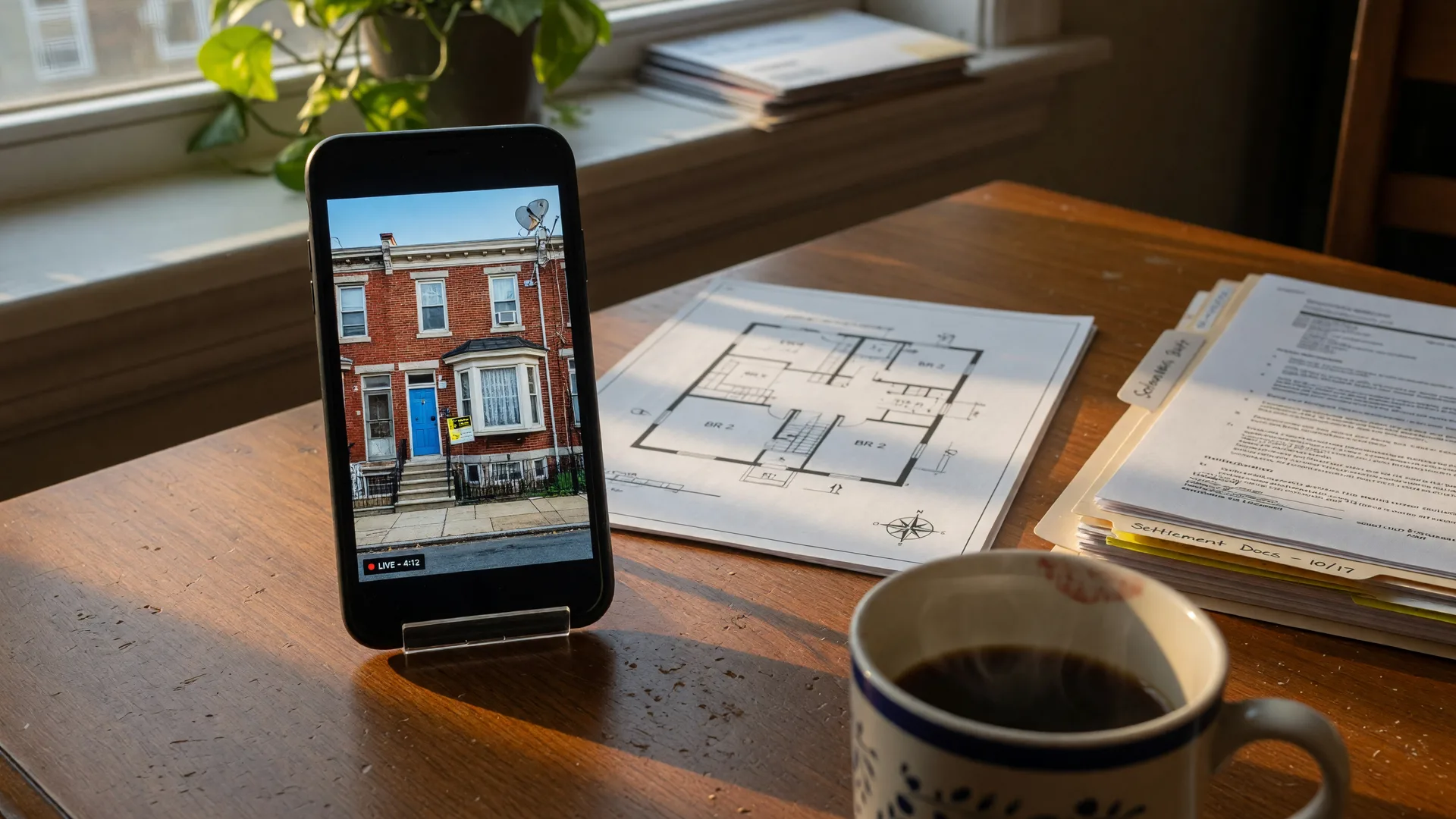
Yes, you can buy a Philadelphia-area home without ever setting foot in it. Pennsylvania allows remote online notarization, power-of-attorney closings, and mail-away signings, and the normal safeguards, inspection, appraisal, and a walkthrough contingency, still apply. What changes is how you verify the house and the block, not whether the deal can close.
I'm Craig Lerch, a broker with eXp Realty who works with relocating buyers, many of whom write offers before they land. This is general information, not legal or financial advice, and it does not replace your lender, your CPA, or a real estate attorney. Figures below were checked in October 2026; rules change, so re-verify anything you rely on before you move.
The short answer: yes, with safeguards
Buying without visiting is routine for out-of-market buyers, not an edge case. NAR's 2024 Profile of Home Buyers and Sellers, covering transactions from July 2023 through June 2024, found buyers typically toured seven homes, about two of them only via virtual tour (NAR, verified October 2026). At the 2020 pandemic peak, a Redfin-commissioned survey put sight-unseen offers at 63 percent, up from 28 percent in 2019 (Redfin, January 2021, verified October 2026); that figure was the pandemic ceiling, not today's normal.
Verification is the part you cannot outsource. A Pennsylvania closing can happen with you in another state or country, but only an inspection reads a house's condition, and only trusted eyes, on the ground or on video, read the block. The contract protects condition through inspection and walkthrough contingencies; your agent protects location through live tours, block walk-throughs, and the data on the street.
How the closing works from a distance
Pennsylvania gives you three ways to sign without being in the room. The first is remote online notarization (RON), made permanent by Act 97 of 2020, effective October 29, 2020, which amended the Revised Uniform Law on Notarial Acts at 57 Pa.C.S. section 306.1. You sign over a recorded, live video call; the notary must be physically in Pennsylvania, and you can be anywhere. Your identity is checked through credential analysis and knowledge-based questions (PA Department of State, verified October 2026).
The second is a power of attorney. Under Pennsylvania's Power of Attorney Act at 20 Pa.C.S. Chapter 56, a power executed on or after January 1, 2015 must be dated, signed by you, acknowledged before a notary, and witnessed by two adults who are not the person acting for you, and the agent signs an acknowledgment of duties before acting (PA General Assembly, verified October 2026). The original is usually recorded with the deed. One catch: lenders often refuse a power of attorney for mortgage documents, so a financed purchase usually closes by remote signing or mail-away instead.
The third is a mail-away closing. Pennsylvania's Uniform Acknowledgment Act lets you sign and notarize in your own state, within the United States, before any notary there, then return the packet; the title company runs the closing and coordinates funds (PA Department of State, verified October 2026).
The numbers that shape a remote buy
A few numbers set expectations. Philadelphia-area homes ran about 50 days on market in the three months ending August 2026, and Pennsylvania typically runs about 37 days from accepted offer to closing (Redfin, ListWithClever, verified September 2026). That 30-to-45-day window matters when you schedule inspections, video tours, and a closing across time zones. Pennsylvania is a title state: a title company and settlement agent run the closing, and an attorney is not required by law (Pennsylvania Association of Realtors, verified September 2026), though a buyer's attorney is a sensible addition on a long-distance purchase and a power of attorney is worth a legal review.
The Pennsylvania Association of Realtors Agreement of Sale defaults to a 10-day inspection window (PAR, verified September 2026). For a remote buyer that window carries the weight: order the inspection the day your offer is accepted, attend it live by video, and keep the inspection and walkthrough contingencies in writing. The seller's disclosure, required under Pennsylvania's Real Estate Seller Disclosure Law at 68 Pa.C.S. Chapter 73, gives you a written condition statement to compare against what the inspector finds (PA statutes, verified September 2026).
How it differs across the metro
Within Pennsylvania, the closing mechanics are the same in the city and the suburbs: remote notarization, power of attorney, and mail-away signing are governed by state law, so the paperwork does not change between a Center City rowhouse and a detached house on the Main Line. What changes is what you verify from a distance: in the city, block-by-block differences, parking, transit, and older rowhouse condition; in the suburbs, the first remote check is which school district serves the exact address, because district lines follow the address, not the town or ZIP.
Cross into New Jersey and a different state governs the deal. New Jersey gives buyers a three-business-day attorney review of the contract (N.J.A.C. 11:5-6.2, verified September 2026), a step Pennsylvania does not have, and New Jersey's transfer tax is a graduated fee that is nominally seller-side. Delaware's state transfer tax runs 3 percent and is customarily split evenly, with New Castle County adding a local share for about 4 percent total (Delaware Division of Revenue, verified September 2026). None of that stops a remote purchase; it changes the checklist, so confirm each state's rules with that title company.
Coming from outside the United States
For an international buyer, three things surprise most. First, you do not have to be in Pennsylvania, or even in the United States, to sign: the Pennsylvania notary joins a recorded video call with you wherever you are (PA Department of State, verified October 2026). Second, you do not need US residency to own real estate here; what changes is financing, tax withholding, and how you hold title, which only your lender and a CPA who handles US tax for non-residents can answer for your situation. Third, the risk flagged most for remote buyers is not legal, it is wire fraud: closing funds move by wire, and email instructions can be spoofed, so the National Association of Realtors' guidance is to verify every wiring instruction by phone at a number you confirmed independently (NAR, verified October 2026).
What most people get wrong
- Sight unseen means buying blind. It means you have not stood in the house; it does not mean you skipped verification. A live video tour, an inspection you attend by video, and a walkthrough contingency cover most of what being there would tell you.
- You must appear in person to sign. Pennsylvania gives you remote notarization, a power of attorney, or a mail-away signing, and any of the three can close the deal (PA Department of State, verified October 2026).
- The closing is the hard part of a remote buy. The paperwork is the easy part; the hard part is verifying condition and block from a distance, which is why the team you line up before the offer matters more than the signing.
- Listing photos tell you what you need. They are marketing. The inspection report and a live walkthrough are the reality check, and on older rowhouses the things photos hide, radiators, wiring, basement condition, are exactly what an inspector is for.
- A sight-unseen offer is rare and reckless. It is common among relocators: NAR's 2024 profile found about two of every seven toured homes were seen only virtually (NAR, verified October 2026). Managed with contingencies, it is a normal path.
Your next step
Build the remote-buy workflow before you write an offer. Step one: confirm with your lender whether the mortgage documents can be signed by remote notarization or a power of attorney, because lender rules vary. Step two: pick the agent who does remote-first tours, and tell them to show the panel, the windows, the basement, and the street, not just the rooms. Step three: the day your offer is accepted, schedule the inspection inside the default 10-day window and attend it by video. Step four: keep the inspection and walkthrough contingencies in writing. Step five: confirm every wire instruction by phone.
Most of my clients buy without landing first. Book a free call and I will walk any home on your shortlist on video, room by room and block by block, so you see what the listing photos skip.