
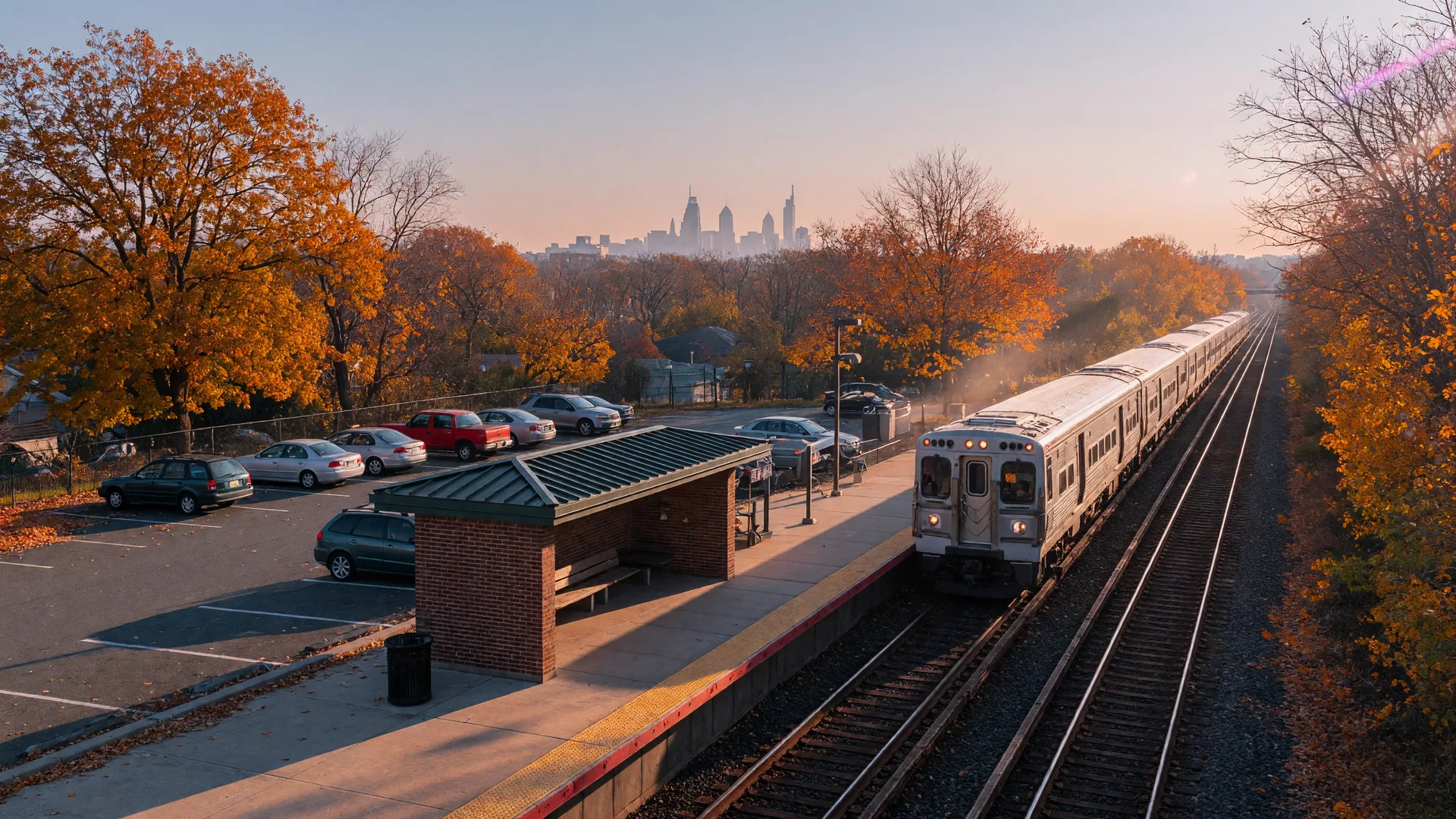
Platform to platform, Amtrak takes about 1 hour 25 minutes from Philadelphia's 30th Street Station to New York Penn Station, and Acela about 1 hour 10, the fastest runs under 1 hour 5. Door to door, count on 2 to 2.5 hours. One-way fares start near $20 booked ahead and climb past $90 at walk-up (verified October 2026).
I'm Craig Lerch, a broker with eXp Realty who works with relocating buyers; this is the commute question I hear most from New York-area buyers. Every figure below was verified in October 2026 against SEPTA, NJ Transit, and Amtrak tables; re-verify it, because fares change on set schedules.
The question, as people actually ask it
The typed version is a plain budget line: "how long is the commute from philadelphia to new york." The schedule makes the trip look short; the lived version runs longer, so the useful answer separates platform time from front-door time. Commuter threads show the pattern people settle into: 2 to 3 days a week is the workable ceiling, consecutive days wear riders down, and the deciding numbers are the monthly cost and the last train, not the fastest advertised run (r/philly and r/Amtrak threads, verified October 2026).
The real answer: platform time versus front-door time
Amtrak's Northeast Regional covers the roughly 90 miles in about 1 hour 25 minutes, and Acela in about 1 hour 10, the fastest runs under 1 hour 5 (Amtrak schedules, verified October 2026). Those are platform-to-platform numbers. Add the ride or walk to 30th Street, the boarding buffer, the walk out of Penn Station's corridors to the street, and the office leg, and the honest planning number is 2 to 2.5 hours one way, matching what long-term commuters report (verified October 2026).
The Philadelphia end carries a surprise most out-of-town buyers miss. 30th Street Station sits on the west bank of the Schuylkill, at the edge of University City, not in Center City. You can walk to it from parts of University City, and it is roughly a mile from Rittenhouse Square. A buyer who assumes any city address works for Amtrak quietly adds 20 to 40 minutes a trip.
The numbers: three ways to make the trip
Amtrak is the direct option, and its one-way fares are dynamically priced like airline seats. Northeast Regional coach runs about $10 to $35 booked in advance, then $45 to $90 at walk-up; Acela runs about $48 to $72 ahead of time and $80 to $250 or more close in (Amtrak fare data via commuter guides, verified October 2026). Booking two to six weeks out moves the monthly number.
The budget rail route is two trains and two tickets. SEPTA's Trenton Line runs from Center City through Northeast Philadelphia and Bucks County to Trenton Transit Center for $11.00, its NJ-zone fare (SEPTA fare table, verified October 2026). At Trenton you transfer to NJ Transit's Northeast Corridor Line, $20.35 one-way to New York Penn Station after the July 1, 2026 fare adjustment (NJ Transit, verified October 2026). The pair costs about $31.35 and runs roughly 2 to 2.5 hours of rail time with the transfer.
Buses fill the flexible-trip niche. FlixBus, Megabus, Greyhound, and OurBus run 170-plus daily departures between the two cities, with typical one-way fares of $8 to $40, but real trip times run about 2 to 2.5 hours and I-95 traffic makes arrivals unpredictable (carrier schedules, verified October 2026).
What a month of commuting actually costs
Run the month for your pattern, not the daily round trip. The unlimited setup: an NJ Transit Trenton-to-Penn monthly pass costs $585, unlimited between the two stations for the calendar month, and the SEPTA Anywhere TrailPass that reaches the NJ zone costs $255 a month (NJ Transit; SEPTA, verified October 2026). Together, the two-ticket unlimited commute runs about $840 a month.
The Amtrak month depends on booking timing and frequency. Six one-ways a week, three round trips, at typical advance fares of $20 to $35 lands roughly between $500 and $900 a month, which is why two to three days a week on advance fares is the commuter default, and why riders describe the workable third day as a midweek overnight (r/philly and r/Amtrak, verified October 2026). At four or five days a week the pass combination wins on price; the strain is what actually caps it.
Where the commute differs across the metro
The commute is a property feature, and it changes with the address. In the city, the shortest door-to-door sits within walking distance of 30th Street Station, which points to University City. Northeast Philadelphia and the Bucks County river towns on the Trenton Line, Cornwells Heights, Croydon, Bristol, and Levittown, ride one SEPTA train to the transfer with no driving. Farther out on the Main Line, you ride SEPTA into Center City first and add roughly 30 to 45 minutes before Amtrak leaves. In South Jersey, the pattern starts from an NJ Transit station such as Hamilton or Princeton Junction, no SEPTA leg. In Delaware, Amtrak stops at Wilmington and Newark on the way to Penn Station (SEPTA, NJ Transit, Amtrak, verified October 2026).
What surprises New Yorkers most
The pricing model is the first shock. New Yorkers know a flat fare and a turnstile; Philadelphia to New York is priced like an airline, and the same seat can cost $19 or $90 depending on when you buy. There is no OMNY-style card across operators; SEPTA and NJ Transit sell separate fares, and a SEPTA pass buys nothing on NJ Transit (SEPTA; NJ Transit, verified October 2026).
Frequencies are commuter rail, not subway. The Trenton Line runs about 50 weekday trains, roughly every 20 to 30 minutes at peak and closer to hourly off-peak, so a missed train costs the better part of an hour (SEPTA schedules, verified October 2026). NJ Transit's fares also rise 3 percent every July 1 by policy, which is how the one-way Trenton-to-Penn fare reached $20.35 this year (NJ Transit, verified October 2026).
The last train decides your evening. NJ Transit's final departure from New York Penn toward Trenton leaves shortly after midnight, so staying late means an overnight or an expensive ride home (NJ Transit schedules, verified October 2026).
What most people get wrong
- "It's 90 minutes." That is the best-case platform-to-platform number on Acela. The planning number is 2 to 2.5 hours door to door, and the difference decides whether twice a week works.
- "I'll buy a monthly pass." On this corridor the monthly is the two-operator $840 combination, and it only beats advance Amtrak fares at four or more days a week. Buy individual tickets ahead instead.
- "SEPTA and NJ Transit work as one system." They connect at Trenton, but they are two operators with two fares, and a missed connection is yours to absorb, not theirs to fix.
- "The bus is the same trip, cheaper." It is cheaper, and for a weekend visit it is the right call. For a Tuesday morning meeting, I-95 traffic means the bus cannot guarantee when you arrive.
Run the numbers for your actual pattern
- Fix the pattern: days a week, arrival time, and does the office mean Penn Station, Midtown, or downtown? The answers change every line below.
- Price the month three ways: advance Amtrak fares for your exact days, the $840 NJ Transit plus SEPTA pass combination, and a bus fallback.
- Measure both ends: walk time from the home in question to 30th Street or its Trenton Line station, and from Penn Station to the office.
- Ride the real train on your next scouting trip. Take the workday departure you would actually use, not a midday sample.
- Check the last-train time and how often winter cancels the evening run; an 8 p.m. departure is a different commitment once you know that record.
- Write the commute into the search: two comparable addresses can sit 40 minutes apart door to door, a tiebreaker you can measure before you offer.
The next step
The commute is the one feature you can measure before you commit, so measure it on the ground. Ride the workday train on your scouting trip and time both ends. Book a free call and we run your pattern.