
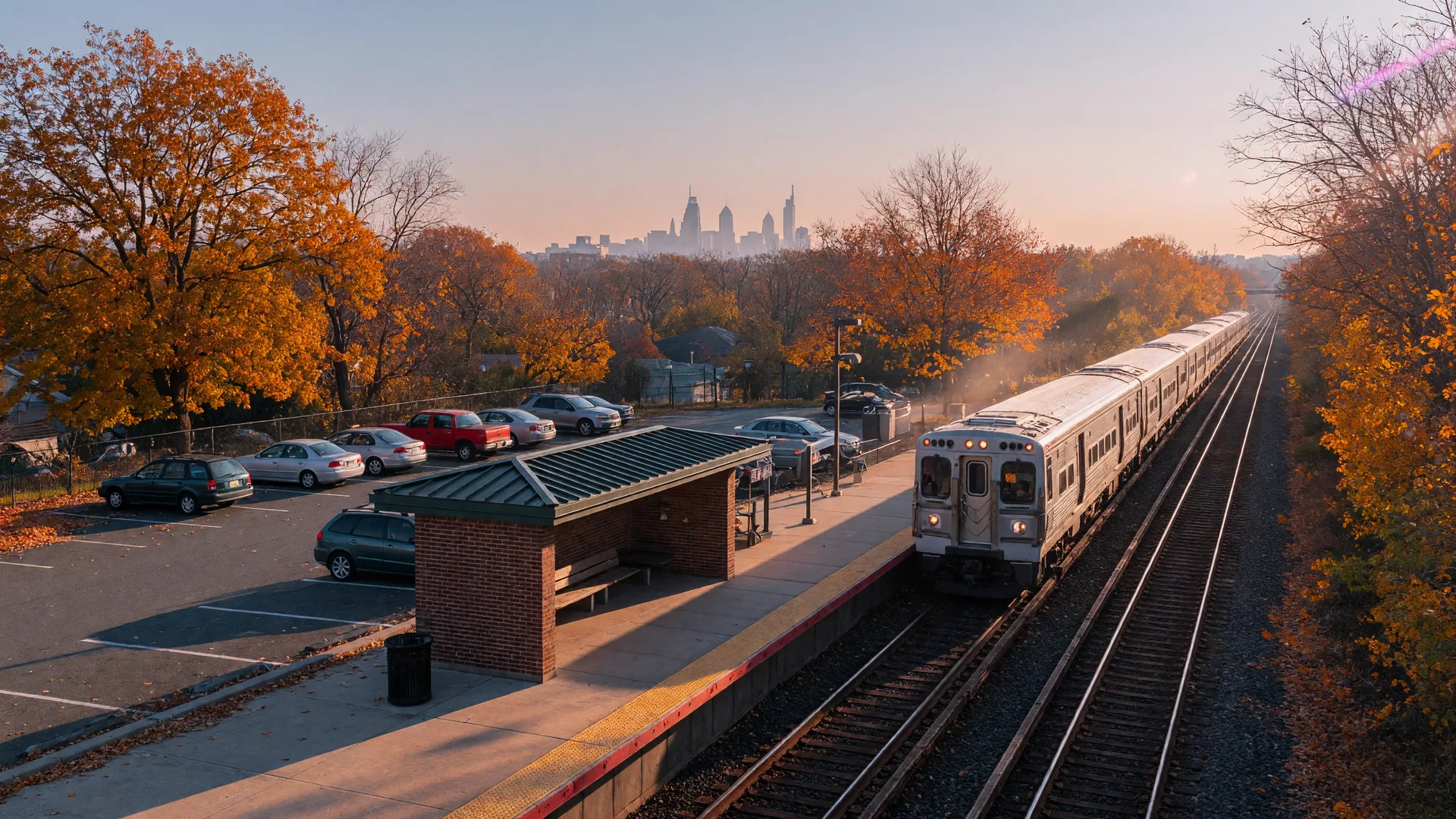
About 155 SEPTA Regional Rail stations across four Pennsylvania counties, nine PATCO stations in New Jersey, and the Wilmington/Newark Line in Delaware put a real share of the Philadelphia suburbs on rail. The catch is geography and schedule: only certain corridors have stations, and off-peak trains on many lines run hourly or less.
I'm Craig Lerch, a broker with eXp Realty, and this is general information, not legal or financial advice. Fares and station lists below were verified against SEPTA and PATCO in October 2026; schedules change, so check the current timetable for the exact station before you commit.
The rail map in one paragraph
SEPTA's Regional Rail network runs 13 lines and about 155 stations across Philadelphia, four Pennsylvania counties (Montgomery, Bucks, Chester, Delaware), Mercer County in New Jersey, and New Castle County in Delaware (SEPTA, verified October 2026). Every line stops in the Center City core at Penn Medicine, 30th Street, Suburban, Jefferson, and Temple University. SEPTA's 2026 map routes many trains through Center City instead of ending them there, so a train from the suburbs can continue out a different corridor after the downtown stops (SEPTA, verified October 2026).
The checklist: how to check a suburb's rail access
A suburb is on rail only if a station exists in it, the train stops on the trips you need, and you can reach the platform. Run these checks for every address on your list.
- Find the station, not the town. A town's name on the rail map does not mean a station in walking distance. Pull SEPTA's station list for the line and measure from the exact address; some suburbs sit several miles from their nearest platform (SEPTA, verified October 2026).
- Check the fare zone. Weekday all-day fares with SEPTA Key, contactless, or a Quick Trip run $5.00 in Zone 1, $6.50 in Zone 2, $7.75 in Zone 3, and $8.75 in Zone 4. Buying on board costs more, from $7.00 and $9.00 up to a $13.00 maximum. Weekends and major holidays use a flat rate (SEPTA fare table, verified October 2026).
- Read the schedule for your exact station. Busy corridors run every 15 to 30 minutes in rush hour; the Airport Line runs about every 30 minutes from early morning to midnight; midday, evening, and quieter lines run hourly or less (SEPTA schedules, verified October 2026).
- Check the last train. Regional Rail is not 24/7. Know the last inbound and outbound trips for your station, because a late evening in the city can mean a long wait or a different way home.
- Check parking at the station. Some stations have lots, others only street parking. SEPTA's station pages list what is available, and a full lot changes the daily math.
- Check the far end of the ride. The Center City stations are not interchangeable: 30th Street, Suburban, Jefferson, and Temple sit in different parts of downtown, and Penn Medicine serves the hospital campus. The walk from platform to office counts.
- Test the line on a real weekday. Riders in r/philadelphia's June 2026 Moving Mondays thread described an easy train ride into Center City from Ardmore and advised padding about 30 minutes of buffer after 2025 and 2026 cancellations tied to fleet inspections (r/philadelphia, June 2026). A trial commute beats a schedule read.
The lines and the suburbs they serve
These are the rail corridors and the suburban towns with stations on them, from SEPTA's current schedules (verified October 2026). Service levels differ line to line, so the list is a starting point, not a timetable.
- Paoli/Thorndale, the Main Line corridor: Merion, Narberth, Wynnewood, Ardmore, Haverford, Bryn Mawr, Rosemont, Villanova, Radnor, St. Davids, Wayne, Strafford, Devon, Berwyn, Daylesford, Paoli, Malvern, Exton, Whitford, Downingtown, and Thorndale.
- Lansdale/Doylestown: Elkins Park, Melrose Park, Jenkintown-Wyncote, Glenside, North Hills, Oreland, Fort Washington, Ambler, Penllyn, Gwynedd Valley, North Wales, Pennbrook, Lansdale, Colmar, Chalfont, New Britain, and Doylestown.
- Media/Wawa: Lansdowne, Clifton-Aldan, Secane, Morton-Rutledge, Swarthmore, Wallingford, Moylan-Rose Valley, Media, Elwyn, and Wawa.
- Manayunk/Norristown: Conshohocken, Spring Mill, Miquon, and Norristown at Elm Street, Main Street, and Norristown Transit Center.
- Other corridors: Chestnut Hill East and Chestnut Hill West reach Chestnut Hill inside the city limits; Warminster ends in Warminster; West Trenton ends in Ewing Township, NJ; the Trenton Line ends in Trenton; and the Wilmington/Newark Line serves Claymont, Wilmington, Churchmans Crossing, and Newark in Delaware.
- Norristown High Speed Line: a separate interurban line, not Regional Rail, running 22 stations from 69th Street in Upper Darby to Norristown, with stops including Bryn Mawr, Haverford, Ardmore Junction, Radnor, Villanova, Gulph Mills, and Norristown Transit Center (SEPTA, verified October 2026).
How it differs across the metro
Inside the city, the base SEPTA fare is $2.90 with two free transfers within two hours on buses, trolleys, and the subway (SEPTA, verified September 2026). Regional Rail is the layer that reaches the suburbs: weekday one-way fares run $5.00 to $8.75 by zone (SEPTA, verified October 2026). Across the river, PATCO runs 24/7 with one-way fares from $1.40 at the Camden stations to $3.00 from Lindenwold, Ashland, or Woodcrest (PATCO, verified October 2026). SEPTA's Trenton and West Trenton lines cover Mercer County, and the Wilmington/Newark Line covers New Castle County, Delaware, from Claymont to Newark (SEPTA, verified October 2026). The same commute question has a different fare, frequency, and last train in the city, a PA suburb, New Jersey, or Delaware.
Coming from NYC or North Jersey
If you are used to NJ Transit or the subway, three things rearrange the plan. First, Regional Rail is commuter rail, not a subway: busy lines run every 15 to 30 minutes at rush hour, but midday and evening service on many lines is hourly or less, and nothing runs all night (SEPTA schedules, verified October 2026). Second, fares are zone-based and paid per ride unless you buy a pass, $5.00 to $8.75 one-way with Key or contactless and more on board (SEPTA, verified October 2026). Third, the network is small: 13 lines and about 155 stations total (SEPTA, verified October 2026). A suburb you like that is not on a rail corridor is a car commute, and no amount of schedule reading changes that.
The pleasant surprise is the river crossing. PATCO is the closest thing this region has to a 24/7 subway into New Jersey, with trains around the clock and fares from $1.40 to $3.00 (PATCO, verified October 2026). And the practical tip from local riders: in r/philadelphia's June 2026 Moving Mondays thread, a poster comparing Wayne and Ardmore for a job in Malvern heard the same advice repeated, that Ardmore is an easy train ride into Center City and that SEPTA's hiccups argue for padding your schedule by about 30 minutes (r/philadelphia, June 2026). Plan the buffer into the commute from the start.
What most people get wrong
- The Main Line has a train. Only the towns on the Paoli/Thorndale corridor, plus the Norristown High Speed Line, have stations. An address between stations still means a drive to the platform (SEPTA, verified October 2026).
- Regional Rail runs like the subway. Off-peak, many lines run hourly or less, and the same trip takes longer once the wait is included. The schedule for your station, not the map, is the fact that matters (SEPTA, verified October 2026).
- Every suburb has rail access. The network covers specific corridors, 13 lines and about 155 stations. Most of the region's housing stock is not near a platform (SEPTA, verified October 2026).
- The fare is the same everywhere. It is zone-based at $5.00 to $8.75 weekday one-way, and buying on board costs more than Key or contactless (SEPTA, verified October 2026).
Your next step
Build the shortlist on addresses, not town names. For each candidate house, find the nearest station and check four numbers: zone, weekday schedule, last train, and station parking. Then ride the line on a weekday at the time you would commute, and time the walk from platform to door at both ends. That trial ride tells you more than any map, and it is the block-level reality a national relocation listicle cannot hand you: the specific station, lot, and platform your commute would actually use.
Ask for the scouting-trip itinerary: a three-day plan built around the trains you would ride, the stations you would use, and the blocks you would walk. One free call and I will send it before you book travel.