
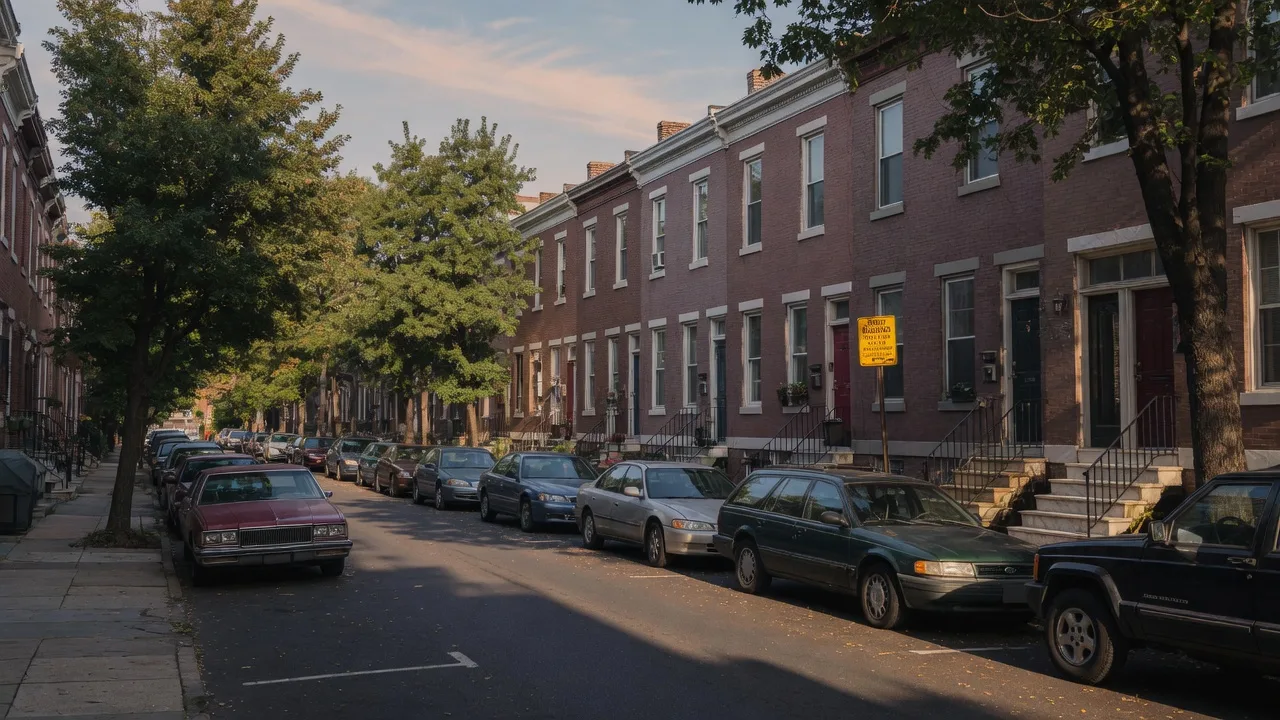
Yes, if you mean street parking in the dense city core, where spots are metered, permit-only, or just scarce. No, if you mean the suburbs, where driveways and garages are the norm and the rules are mostly signs you read on the block. The honest answer is that Philadelphia parking is rule-based: learn the permit zones, the cleaning windows, and the metered blocks, and it stops being a mystery.
Relocating buyers ask about parking early in a call, usually because a listing photo shows a rowhouse with no driveway and they are picturing a second car on the street. I'm Craig Lerch, a licensed broker with eXp Realty, and I have worked the city and the four surrounding Pennsylvania counties for more than 35 years. Every figure below carries a date for re-checking: it reflects what I could verify in September 2026.
The permit is the centerpiece, and it reserves nothing
The city runs a program called Residential Permit Parking, RPP in Philadelphia Code Chapter 12-2700 (Philadelphia Parking Authority, verified September 2026). The city is divided into numbered permit districts, and a resident's permit waives the posted time limits and meters on permit-parking blocks inside that district only. It does not guarantee a spot, it does not own the space in front of your house, and it does nothing a few blocks over. A permit holder still searches, just with a lower chance of a ticket.
Eligibility follows the address: live in the district, hold Pennsylvania plates and registration at that address, show proof of residency such as a lease, utility bill, or driver's license, and carry proof of insurance (Philadelphia Parking Authority application materials, verified September 2026). Renters get a permit on the same terms as owners, and a household is capped at three vehicle permits.
The numbers: what parking actually costs
The residential permit is a flat $75 per vehicle per year, a figure in effect since September 1, 2024; motorcycles and scooters cost $50 (Philadelphia Parking Authority, verified September 2026). A reduced-fee rate exists for households enrolled in assistance programs run by PECO, PGW, and the Water Department, and guest permits are vehicle-specific, nontransferable, and capped at two per vehicle per 60 days, the number to know before out-of-state visitors arrive with a car.
Center City runs on a different system: most on-street spaces there are metered with roughly two-hour limits, and the Parking Authority raised Center City meter rates by $1 an hour in 2025 (Philadelphia Parking Authority news, verified September 2026). Monthly garage leases in the core commonly run a few hundred dollars, so a month of garage rent can cost more than two years of the street permit. For scale, about 8 percent of U.S. households have no vehicle available at all (Census Bureau, 2023), while Philadelphia has long ranked among the most car-free big cities, with city-level analyses putting roughly one in three households without a vehicle, a figure reported from older Census data. Houston, a common Sun Belt origin point, sits near the national average at about 9.6 percent without a vehicle (ACS 2019-2023 via the Houston State of Health data portal, verified September 2026).
Street cleaning: the $31 ticket nobody budgets for
Philadelphia's seasonal Mechanical Cleaning Program runs on weekdays from spring through October 29, 2026, in 14 neighborhoods (City of Philadelphia Streets and Sanitation announcements, verified September 2026). On posted blocks, parking is banned from 9 a.m. to 3 p.m. one day a week, with the exact window shown on the block's sign: 9 to 11 a.m., 11 a.m. to 1 p.m., or 1 to 3 p.m. Enforcement for 2026 began April 20, the fine for parking through a window is $31, and cars get tickets, not tows. The city's SweepPHL map at StreetSmartPHL.phila.gov shows the cleaning day for any address, so check a block before you tour it and again before you bid.
The scale matters: sweeping applies only on posted blocks in those 14 neighborhoods, not citywide. On most city streets there is no cleaning window at all, and the sign on the block is the final word.
City, PA suburbs, New Jersey, Delaware: how parking differs
Inside the city, parking is a street-rules question layered onto the housing stock: many attached rowhomes have no driveway or garage, so off-street parking, when it exists, means a rear garage, an alley spot, or a dedicated pad behind the building. A house with any form of off-street space is a feature worth writing into your comparison, and the listing's parking field plus a walk of the block is how you verify it.
In the four suburban Pennsylvania counties, Montgomery, Bucks, Chester, and Delaware, driveways and attached garages are the norm, street parking is rarely restricted beyond municipal rules you check at the town office, and regional rail stations run park-and-ride lots, so the question shifts from whether you can park to how you reach the station. South Jersey and Northern Delaware follow the same suburban pattern, with lots at NJ Transit and PATCO stations. The city is the one part of the metro where the parking system becomes part of the housing decision, and even there it is learnable in an afternoon.
What surprises someone moving from the Sun Belt
Coming from Houston, Phoenix, Atlanta, Dallas, or Tampa, the first surprise is that parking runs on rules instead of lots. You pay $75 a year for the privilege of still searching, and the permit works only in your district on permit blocks. The second surprise is the housing: in Sun Belt metros a driveway, a garage, and free surface lots are the assumed baseline, while a large share of Philadelphia's rowhouse stock has no off-street parking at all.
The third surprise is administrative and fixed: Pennsylvania gives you 60 days to get a state driver's license and 20 days to title and register your vehicle after establishing residency, and the city permit itself requires Pennsylvania plates and registration at the new address (PennDOT via pa.gov, verified September 2026). The order matters: registration first, permit second, then temporary and visitor permits while you sort the rest. The fourth is seasonal. In the Sun Belt you rarely move a car for a city program; here a sweeping window moves your car one weekday, and a declared snow emergency empties the posted routes. None of it is complicated, but none of it shows up in a national moving listicle.
What most people get wrong
- A residential permit reserves your spot. It does not. It only waives time limits and meters on permit blocks inside your district.
- The permit works anywhere in your ZIP. Permit rules are per district and per block, and a few streets over can be a different system entirely.
- It is an RCO permit. The program is Residential Permit Parking under Philadelphia Code Chapter 12-2700 (verified September 2026). RCO stands for Registered Community Organization, a zoning term for neighborhood groups, and it is not a parking permit.
- Street cleaning applies everywhere, all year. It runs on posted blocks in 14 neighborhoods, seasonally, with the window on the sign and in SweepPHL.
- A garage or driveway is a minor detail. In the city it can be the difference between a straight pull-in and a nightly search; in the suburbs it is the assumption. Read it as the feature it is.
Test parking on the block before you bid
- Read the signs on the actual block: permit hours, meter hours, and any sweeping window, and note whether it is a permit block at all.
- Check the address in SweepPHL and the city's parking tools to confirm the cleaning day and any posted event restrictions near large venues.
- Ask the listing agent to confirm parking in writing: driveway, garage, rear access, dedicated spot, or street only.
- If you will commute, check park-and-ride capacity at the regional rail, NJ Transit, or PATCO station you would actually use.
- Visit the block twice: once on a weekday evening and once mid-morning on a cleaning day. The two experiences are different.
Your concrete next step
Parking should sit in the criteria list before the search starts, not after an offer: off-street spot, permit district, sweeping day, and station parking all belong with the other non-negotiables. Turn this into a short-list filter: add those four items to your neighborhood-criteria worksheet and score every candidate address on it.