
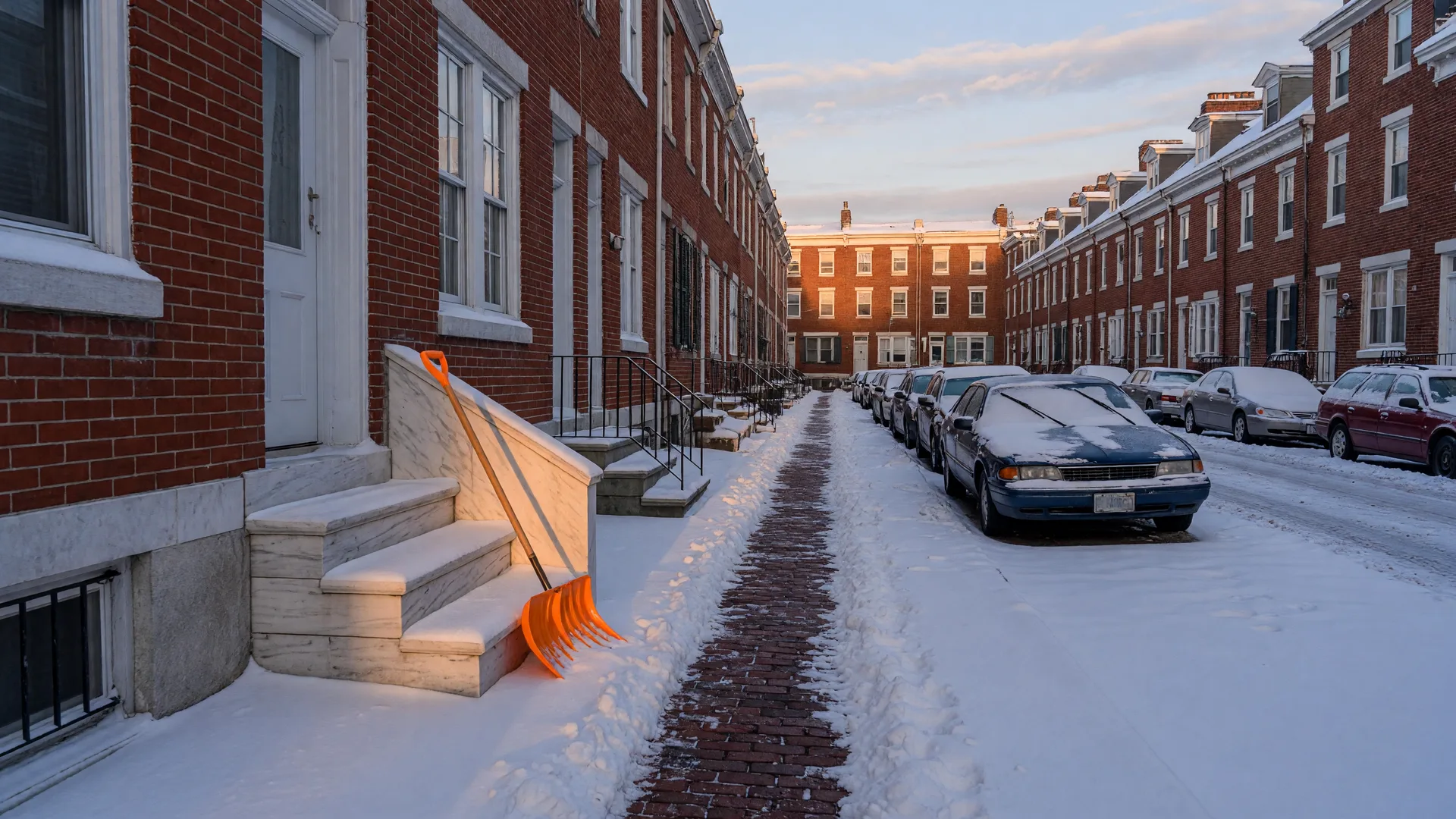
In Philadelphia, you do: the owner, agent, and tenants of a property are all responsible for clearing a path at least 36 inches wide on every sidewalk abutting the building within six hours after the snow stops. Piling snow in the street is illegal, and fines run $50 to $300 per violation. The city clears streets, not sidewalks.
I'm Craig Lerch, a broker at eXp Realty, and the snow question comes up in nearly every relocation call from New England. Buyers assume a Philadelphia winter runs like a Boston winter, and it mostly does not. The difference starts at the curb.
The sidewalk is your job, not the city's
Philadelphia Code section 10-720, Snow Removal from Sidewalks, assigns the work to the people who own and occupy the property: the owner, the agent, and the tenants must clear a path of not less than 36 inches in width on all sidewalks abutting the building, including curb cuts, within 6 hours after the snow has ceased to fall (Philadelphia Code; Department of Streets, verified October 2026).
The clock is flat: if the snow stops at 2 a.m., the path is due by 8 a.m., with no overnight carve-out, unlike Boston's rule (more below). The path also has to stay clear of ice, so salt, sand, or another treatment is part of the job, and snow or ice cannot be placed or piled in the street.
If you rent, read the lease before the first storm. The code names tenants alongside owners, so a lease that assigns shoveling to the tenant is normal on rowhouse blocks, but the assignment should be in writing. If you buy, you inherit the obligation on closing day, whether or not you have moved in yet.
The numbers, with sources
- Path: at least 36 inches wide on every sidewalk and curb cut, within 6 hours after the snow stops (Code 10-720, verified October 2026).
- Fine: $50 minimum, up to $300 per violation (sections 10-718 and 10-719).
- Street piling: prohibited. Snow and ice must not be pushed into the street.
- Snow emergency routes: about 110 miles, marked with red signs (Department of Streets, verified October 2026).
- Towed cars: call 215-686-SNOW during a snow emergency to find your vehicle.
How the city actually plows
Plowing runs in tiers: snow emergency routes and primary roads first, then secondary roads, then residential streets. A full deployment of about 450 to 800-plus trucks happens when about 5 inches or more falls; below that, crews salt and plow primary and secondary roads, residential streets on hills, and one lane of high-elevation residential streets, and flat side streets are not guaranteed a plow (Department of Streets, verified October 2026).
Two consequences follow for buyers. First, your block may sit unplowed for days after a storm, which matters on street-parking rowhouse blocks and for anyone who needs a car for work. Second, the city does not clear sidewalks, ever, and it does not hand out free salt at fire stations: officials debunked that rumor during the January 2026 storm (Inquirer and 6abc coverage, verified October 2026).
Snow emergencies are parking events
A snow emergency is a parking rule, not just a plowing announcement. When severe winter weather is forecast, the city declares one, and no vehicle may remain parked on any posted snow emergency route from the moment it takes effect. Cars left there are ticketed and towed; call 215-686-SNOW to find a towed vehicle (Office of Emergency Management; Department of Streets, verified October 2026).
The Philadelphia Parking Authority softens the blow: during a declared emergency, a flat $5 24-hour rate applies at select Center City garages, including AutoPark at Independence Mall (5th and Market) and the Family Court Garage (1503-11 Arch). Take a ticket on the way in and pay the discounted rate at the PPA management office inside the garage, not the exit kiosk. Meter and time-limit violations on residential blocks are not enforced until the emergency is lifted (philapark.org, verified October 2026).
How it differs across the metro
No state in the region has a statewide sidewalk law: Pennsylvania, New Jersey, and Delaware each leave the rule to the municipality, so the deadline, width, and fine vary town by town. Philadelphia's 6-hour clock is among the strictest in the region. In Delaware County, Lansdowne allows 24 hours with a 2-foot path, Media and Springfield 24 hours with 3-foot paths, and Upper Darby 24 hours with a 30-inch path; in Montgomery County, Upper Dublin and West Norriton set 20-inch paths (municipal ordinances via Laffey Bucci, verified October 2026).
New Jersey's 564 municipalities each write their own rule, with common windows from about 8 to 24 hours: Jersey City gives residential properties 8 hours and businesses 4, Newark 12, Hackensack six hours of daylight, North Haledon 24, and Wayne up to 48 (NJ 101.5 and NorthJersey.com, verified October 2026). Delaware's largest cities run about 24 hours (Wilmington, Dover, Newark), with Wilmington requiring a path at least 2 feet wide on the half of the sidewalk nearest the building, and Clayton allowing 48 (Delaware Online, verified October 2026).
The method matters more than any single number: before you offer, look up the municipal code for the exact town and block, because the rule you inherit is the one on that street, not the one next door.
What surprises someone from Boston
Bostonians already shovel, so the surprise is the rule, not the chore. Boston clears within 3 hours after a snowfall stops, or within 3 hours after sunrise if it snowed overnight, keeps a path at least 42 inches wide, and fines per day: $50 for smaller residential buildings, $100 for buildings with 16 or more units, $200 for commercial (City of Boston, verified October 2026). Philadelphia gives you 6 hours, asks for 36 inches, and fines $50 to $300 per violation.
The snow totals are not close either. NOAA's 1991-2020 normals put Philadelphia at 23.1 inches of snow a year with about 12 snowy days, against about 49 inches for Boston, and January averages run 41.3 degrees high and 26.8 low in Philadelphia versus 36.8 and 23.1 in Boston (NOAA NCEI, verified October 2026). Philadelphia sits closer to the winter rain-snow line, so storms that are all snow in New England often arrive here as a mix of snow, sleet, and freezing rain; NOAA does not publish a freezing-rain-day normal for either city, so treat that as general climatology.
The third surprise is parking. Rowhouse blocks have little off-street parking, so the snow emergency rule, tow from the red routes, $5 garages, is a bigger part of a Philadelphia winter than the equivalent rule is in Boston.
What most people get wrong
- The city will clear my sidewalk. It will not. That is the owner's job under section 10-720.
- There is free salt at fire stations. There is not. The city debunked that rumor in January 2026.
- A few inches means my street gets plowed. Not necessarily. Below about 5 inches, side streets are not guaranteed a plow.
- I can push the snow into the street. No. Piling snow or ice in the street is prohibited.
The detail a national listicle will not give you: the 36-inch path includes curb cuts, so the law is written for a wheelchair or a stroller to actually use, and fines are per violation, meaning a landlord with several buildings can face several fines from one storm. That is why the sidewalk question belongs on the checklist before you offer, not after you close.
Your next step
Before you offer, run a winter test on the block: who clears the sidewalk at the building you are buying (you will inherit it), whether the street is a posted snow emergency route, where your car goes during an emergency, and what the municipal code says. If renting, check the lease; if buying, ask the seller how the last two winters went.
Before you fly in, take a winter scouting trip: walk the block at 7 a.m., check the sidewalk, and ask who clears it. I'll send you my scouting-trip itinerary for relocating buyers. Book a free call.
This is general information, not legal advice. Sidewalk liability and lease language vary by property, so for a specific dispute an attorney is the right stop, and your town's code is the number to verify before you rely on any deadline here.